
.png) 1 hour ago
1
1 hour ago
1
The Nigerian Communications Commission (NCC) has clarified the rationale behind its evolving Quality of Service (QoS) enforcement framework, which now prioritises direct compensation to subscribers over traditional financial penalties paid to government coffers.
Edoyemi Ogoh, director of Technical Standards and Network Integrity at the NCC, provided insight into the policy shift during a televised interview monitored by Techeconomy, explaining that the Commission’s actions remain firmly rooted in existing regulatory instruments but are increasingly guided by consumer-centric outcomes.
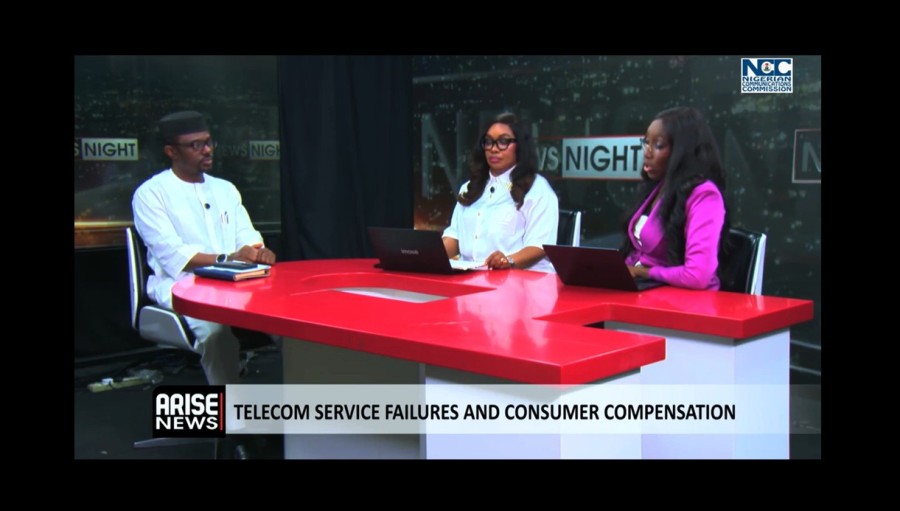 Edoyemi Ogoh on AriseTV
From Penalties to Consumer Redress
Historically, Nigeria’s telecom regulator enforced QoS compliance through monetary sanctions imposed on operators that failed to meet prescribed performance thresholds.
Under these rules, telecom service providers were required to pay fines of up to ₦5 million per Key Performance Indicator (KPI) per reporting area where service quality fell short.
These reporting areas, geographical zones used by the NCC to assess network performance, form the basis of nationwide QoS monitoring, covering metrics such as call drop rates, network accessibility, and data service quality.
In the past, such penalties were paid directly to the government.
However, Ogoh noted that the Commission is now rethinking this approach in favour of a more consumer-focused model.
“We recognise that the subscribers are the ones who actually experience the poor quality of service. It is only fair that the impact of any sanctions imposed should be felt directly by them,” he said.
Why the Policy Shift Matters
The new direction reflects a broader regulatory philosophy: ensuring that enforcement actions not only punish non-compliance but also provide tangible relief to affected users.
Rather than treating QoS breaches solely as regulatory infractions, the NCC is positioning them as consumer rights issues, requiring remediation that directly benefits end users.
This shift aligns with global best practices, where telecom regulators are increasingly mandating service credits, refunds, or other forms of compensation when operators fail to deliver agreed service standards.
Strengthening Accountability in Nigeria’s Telecom Sector
Nigeria’s telecom industry, one of the largest in Africa with over 200 million active subscriptions, has faced persistent complaints around network congestion, dropped calls, and inconsistent data speeds, especially in high-density urban centres.
By redirecting penalties toward subscribers, the NCC aims to improve accountability among telecom operators; enhance customer trust in regulatory oversight; create financial incentives for operators to maintain service quality, and ensure that regulatory actions produce measurable consumer benefit.
Regulatory Backing and Implementation
Ogoh emphasised that the Commission’s actions remain grounded in its existing regulatory framework, which clearly defines QoS benchmarks, monitoring mechanisms, and enforcement procedures.
The shift, therefore, is not a departure from regulation but an evolution in how sanctions are applied.
“Whatever we do is guided by regulations in force. The difference now is ensuring that the outcome of those regulations directly addresses the experience of the subscriber,” he explained.
A Consumer-Centric Future
Industry analysts say the move could mark a turning point in Nigeria’s telecom regulation, especially as demand for high-quality voice and data services continues to rise with the expansion of digital services, fintech, streaming, and remote work.
If effectively implemented, the policy could set a precedent for other sectors where service delivery impacts millions of consumers daily.
For subscribers long frustrated by poor network performance, the NCC’s new approach signals a clear message: service failures will no longer just attract fines, they will trigger direct compensation.
The post Edoyemi Ogoh Explains Why NCC Shifted QoS Sanctions to Direct Subscriber Compensation appeared first on Tech | Business | Economy.