.png) 1 hour ago
1
1 hour ago
1
A May 2026 report on the best AI chatbots found that Perplexity AI is the most reliable tool for everyday work tasks.
With 1 in 4 American workers now using AI assistants regularly, a new study by Legal Guardian Digital, an attorney SEO company, reveals which chatbots make the fewest mistakes and stay online when you need them.
- Perplexity AI is the most reliable chatbot for daily tasks, giving false information only 13% of the time compared to 22% industry average.
- With a 100% uptime rate, Grok virtually never goes offline, while competitors like Claude often experience outages.
- ChatGPT makes twice as many errors as Chinese DeepSeek, with wrong answers appearing in 30% of responses despite its 60% market share.
The research examined popular AI chatbots to find which ones workers can trust most. The report measured how often each chatbot gives false information, tracked customer satisfaction ratings, and monitored how consistently they return responses.
The study also looked at uptime rates, showing how often each service stays available without crashing.
These factors were combined into reliability scores, with chatbots that make fewer mistakes and stay online more regularly ranking higher.
Most Reliable chatbots for Everyday Jobs:
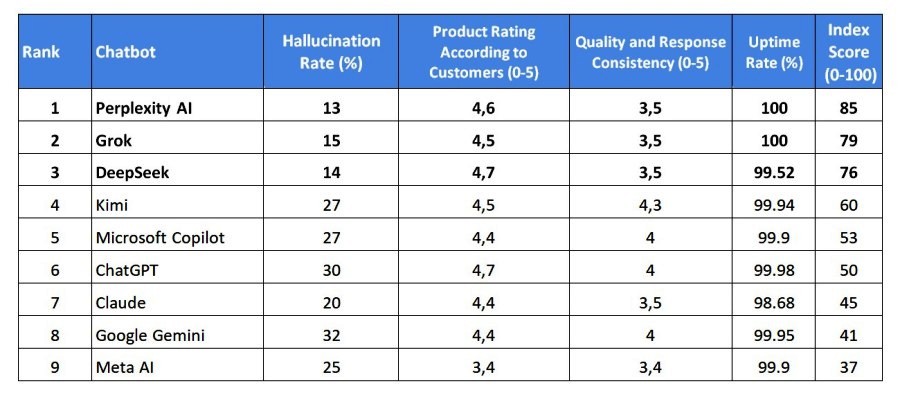 | You can access the complete research findings here. Credit: Legal Guardian Digital
1. Perplexity AI
- Hallucination rate: 13%
- Product rating: 4.6/5
- Quality and consistency: 3.5/5
- Uptime rate: 100%
- Monthly cost: $40
- Reliability score: 84.8/100
Perplexity AI is the most reliable chatbot for work tasks right now. The service gets things wrong just 13% of the time, meaning employees get accurate answers in nearly 9 out of 10 queries. That’s less than half the error rate ChatGPT records.
Perplexity also never goes offline, maintaining 100% uptime while competitors like Claude face regular crashes. Users pay $40 monthly for this reliability, double what ChatGPT costs, but customer ratings of 4.6 out of 5 indicate it might be worth it.
2. Grok
Grok comes second with a hallucination rate of 15%, just slightly behind Perplexity. Like the top-ranked chatbot, Grok records 100% uptime, so workers never face “service unavailable” errors during important tasks.
The platform costs $30 monthly and earns solid ratings from users at 4.5 out of 5.
Where Grok falls short compared to Perplexity is answer consistency, though, scoring 3.5/5, which means responses can vary more depending on how questions are phrased.
3. DeepSeek
DeepSeek ranks third among the most reliable LLMs. Despite being free to use, the chatbot gives wrong answers only 14% of the time, making it more accurate than paid services like ChatGPT or Microsoft Copilot.
DeepSeek also gets the highest product rating at 4.7 out of 5, suggesting users are happy with the results they get for free.
The service does go offline occasionally, though, so workers might face downtime a few times per month during heavy usage periods.
4. Kimi
Kimi takes fourth place as the most consistent chatbot on the market right now. Even though it’s probably one of the least popular options, Kimi scores 4.3 out of 5 for quality answers across different types of questions, higher than any competitor.
This makes Kimi useful for workers who need longer chats but don’t want their AI tools to lose track in mid-conversation. Kimi’s error rate is at 27%, but it costs just $19 monthly and rarely crashes.
5. Microsoft Copilot
Microsoft Copilot rounds out the top five with a 27% hallucination, similar to Kimi. At $20 monthly, Copilot costs about the same as ChatGPT but gets things wrong less often. The service stays online 99.9% of the time and scores 4 out of 5 for consistency, putting it in the middle of the rankings. While Copilot holds only 12.8% of the market right now, it’s become one of the most common chatbots in corporate settings.
Austin Hunt, CEO at Legal Guardian Digital, commented on the study:
“People assume ChatGPT is the most reliable because it’s the most popular, but that’s not true. Its market share comes from being first and having the best marketing, not from being the best product. ChatGPT’s 30% hallucination rate means three out of ten answers contain false information. And that can be a serious problem when people use it for research, to review laws, or to make business decisions. When you actually measure error rates and uptime, smaller chatbots like Perplexity and Grok beat the big names.”
The post Most Reliable Chatbots for Everyday Jobs appeared first on Tech | Business | Economy.