
 1 month ago
23
1 month ago
23
Airtel and Globacom, two of Nigeria’s leading telcos, have resumed airtime lending after the country’s consumer protection regulator suspended enforcement of controversial digital lending rules that had temporarily disrupted the market.
The Federal Competition and Consumer Protection Commission (FCCPC) said in a public notice on May 22 that it had suspended enforcement of its Digital, Electronic, Online or Non-Traditional Consumer Lending Regulations (DEON Regulations) 2025, following an interim order issued by the Federal High Court in Lagos.
The court order, issued by Justice A.L. Allagoa on April 15, restrained the FCCPC from implementing the rules after a lawsuit filed by Wireless Application Service Providers Association of Nigeria (WASPAN).
The restoration reopens access to services such as “Borrow Me Credit” by Globacom and airtime advances that millions of subscribers rely on for emergency communication needs.
“As we speak, the services in question are already active on Airtel and Glo,” Ayo Stuffman, chairman of WASPAN, told TechCabal on Monday. “On MTN, I can speak that we are confident of the resumption of services given the recent developments from the FCCPC.”
TechCabal independently confirmed that Globacom and Airtel have relisted airtime lending services on their platforms.
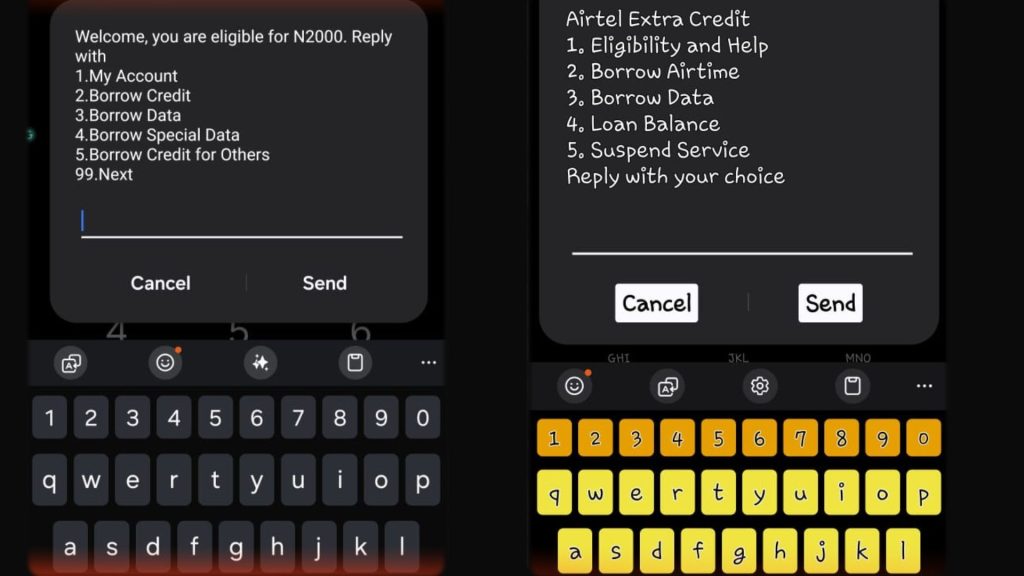
Airtime credit listed on both Globacom and Airtel. Image source: TechCabal.
The dispute over the new lending rules began after the FCCPC broadened the scope of its DEON Regulations to include telecom airtime and data credit services, classifying them as digital lending.
Under the rules, telecom operators offering deferred-payment airtime or data services would be treated as lenders and required to comply with registration, disclosure, and consumer protection obligations.
The move triggered a standoff between telecom operators, regulators, and value-added service providers.
WASPAN argued in court that airtime credit should not be classified as a conventional loan because it operates as a telecom value-added service already regulated under the Nigerian Communications Commission (NCC) framework.
“What WASPAN has advocated for through the courts is that the DEON Regulations shouldn’t apply to airtime credit, which can’t really be classified as a loan in the actual sense,” Stuffman said.
The regulatory clash forced operators, including MTN, Airtel, and Globacom, to suspend airtime credit services in April to avoid potential sanctions under the FCCPC framework. The disruption froze a market estimated to process hundreds of billions of naira annually and affected millions of low-income users who depend on small airtime advances, according to WASPAN.
The DEON Regulations were first introduced in July 2025 to curb abusive practices by digital loan apps, including harassment, public shaming of debtors, and opaque lending terms. However, the regulations adopted a broad definition of lending that extended beyond cash loans to include airtime credit, deferred-payment data bundles, and buy-now-pay-later services.
Under the rules, companies offering digital credit services could face penalties of up to ₦100 million ($72,886) or 1% of annual turnover for non-compliance.
Industry stakeholders argued that applying the same framework designed for loan apps to telecom services risks creating unnecessary regulatory overlap and operational disruption.
At a press briefing in April, the NCC executive vice chairman, Aminu Maida, maintained that airtime credit falls under telecom value-added services governed by the Communications Act, not consumer lending.
Despite the temporary suspension, uncertainty remains over the long-term regulatory treatment of airtime credit services. The FCCPC said it plans to challenge the court order, while operators are expected to push for a harmonised framework between the consumer protection and telecom regulators.
“The Commission has also given its solicitors firm instructions to challenge the Order and the competence of the suit,” FCCPC said in its notice.
For now, however, the restoration of the services will come as relief to millions of Nigerians who rely on airtime advances during emergencies or temporary cash shortages.
“Our members trust that the rule of law supersedes at the end of the day despite the revenue loss over six weeks,” Stuffman said.










 English (US) ·