
 2 hours ago
1
2 hours ago
1
The 2026 International Greenwich Olympiad (IGO), a global project-based competition for students aged 10 to 19, brought young innovators from across Europe, Asia, Africa, Australia and the Americas to Queen Mary University of London in June, with participants presenting solutions to real-world challenges tied to the United Nations Sustainable Development Goals (SDGs).
The competition was hosted by North London Grammar School, with support from Queen Mary University of London, while King’s College London hosted the awards ceremony. Judges were drawn from leading universities and industry, according to the school’s headteacher.
A gold medal from Uganda
The Olympiad’s overall winner in the STEM Lesson Presentation category was Roshan Aitham Karoobi, a 13-year-old Senior One student at Light Academy Secondary School in Entebbe, Uganda.
His project, Physics in Action: How a Fruit-Picking Robot Uses Newton’s Laws of Motion, earned Uganda its only gold medal of the competition, with two other Ugandan students also receiving international recognition for engineering work.
Organisers: a platform for collaboration, not just competition
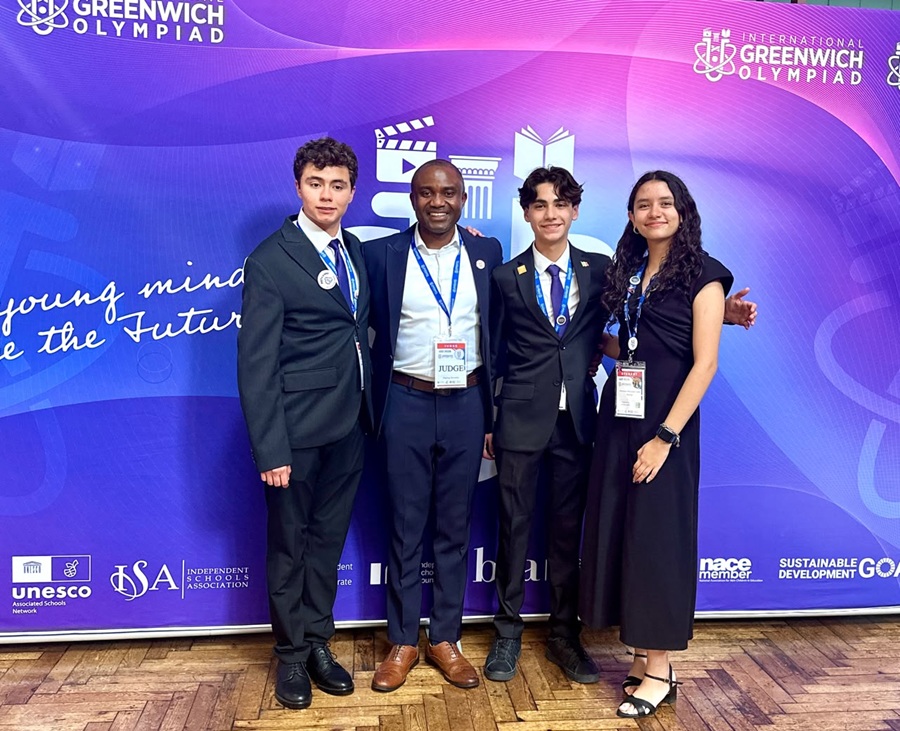 Participants at the 2026 International Greenwich Olympiad (IGO) in London
Fatih Adak, Headteacher of North London Grammar School, described IGO as designed to function beyond a standard competition format.
“IGO is more than a competition, it is a platform for young innovators to collaborate, tackle global challenges, and develop ideas that can shape a better future,” Adak wrote in a LinkedIn post following the event.
Adak said every project entered was aligned with the SDGs, and thanked judges, staff, volunteers and guests, including the Lord Mayor of Oxford, Chewe Munkonge, and the ACN Group Chairman and Director, for their roles in the event.
“Most importantly, congratulations to all of our students. Your creativity, passion, and determination to make a positive impact on the world are truly inspiring,” he wrote.
Denisa Van Ruymbeke, President of MILSET Europe, the regional body for the International Movement for Leisure Activities in Science and Technology, which promotes STEAM education and youth scientific engagement, echoed that sentiment at the awards ceremony, describing the atmosphere as “just incredible.”
“All the students were celebrating the science and art, and I would like to congratulate them, because they did the first step to their future,” Van Ruymbeke said.
Judges weigh responsibility alongside innovation
Among the judges evaluating entries was Tosin Joseph, who assessed 12 teams in the AI category against nine criteria covering innovation, technical merit, feasibility, sustainability and societal impact.
He said the standout entries were distinguished less by technical sophistication than by how thoroughly participants had considered the consequences of deploying their ideas.
“The strongest teams weren’t necessarily those with the most advanced technology,” Tosin said. “They were the teams that had already considered how their solutions could be deployed responsibly, where the risks might emerge, and how those risks could be mitigated before anyone asked them.”
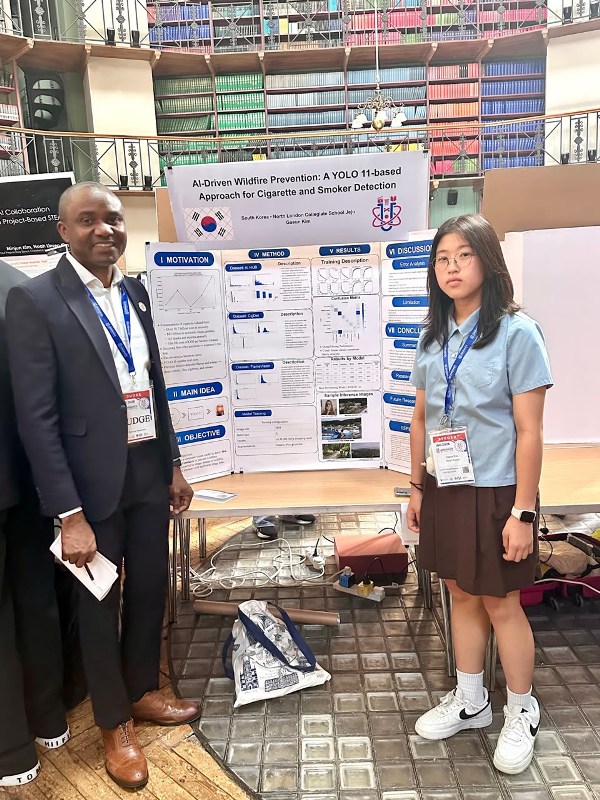 Tosin Joseph and another participant
“In all, IGO 2026 demonstrates how the UK can position itself as a destination where emerging global talent is not only welcomed but evaluated against world-class standards. That matters because the future of AI depends as much on developing responsible innovators as it does on advancing technology”, he added.
Tosin said he placed particular weight on ethical AI considerations during judging, safety, bias mitigation, transparency and responsible deployment, describing these as principles increasingly shaping AI regulation internationally. “Innovation without responsibility is incomplete,” he said.
UK’s positioning in global STEM competition
Both Van Ruymbeke and Joseph pointed to the UK’s hosting role as carrying wider significance. Joseph said the event “demonstrates how the UK can position itself as a destination where emerging global talent is not only welcomed but evaluated against world-class standards,” while noting British students should also benefit from more exposure to competitive international environments.
Adak’s account, drawn from his role organising the event, and the judges’ reflections together point to an event organisers are positioning as a growing fixture on the UK’s youth STEM calendar, though neither the scale of that ambition nor the Olympiad’s long-term funding model is detailed in available materials.
The post Judges and organisers Hail UK’s Role in STEM as IGO Draws 500 Innovators from 50+ Countries appeared first on Tech | Business | Economy.











 English (US) ·