.png) 19 hours ago
2
19 hours ago
2
Mark Olilla, founding director of the Arizona State University’s Endless Games and Learning Lab; and Bola Akinrolabu, assistant director of the Endless Games and Learning Lab at Arizona State University, unpack the vision, structure, and long-term impact the partnership with Maliyo Games will have in the education sector in Africa and beyond.
From ASU’s perspective, this initiative reflects a broader shift in global education. According to Oliver, ASU is the largest public university in the United States, with approximately 180,000 students, half on campus and half online. The institution’s long-standing vision, driven by its leadership, is centred on accessibility and adaptability.
“Not everyone can learn through traditional methods. We need the flexibility to go to where learning takes place,” Oliver explained.
This philosophy has shaped ASU’s approach to education, focusing on multiple learning pathways that allow students to achieve outcomes tailored to their individual goals.
Understanding the ‘Five Realms’ of Education
“ASU’s evolving education model is structured around five distinct ‘realms’: Traditional classroom learning, online and digital learning environments, immersive exploration through technologies like virtual reality, and finally, infinitely scalable learning systems. The Endless Games and Learning Lab represents ASU’s first “Realm Five” initiative, focused on delivering education at scale,” Oliver emphasised.
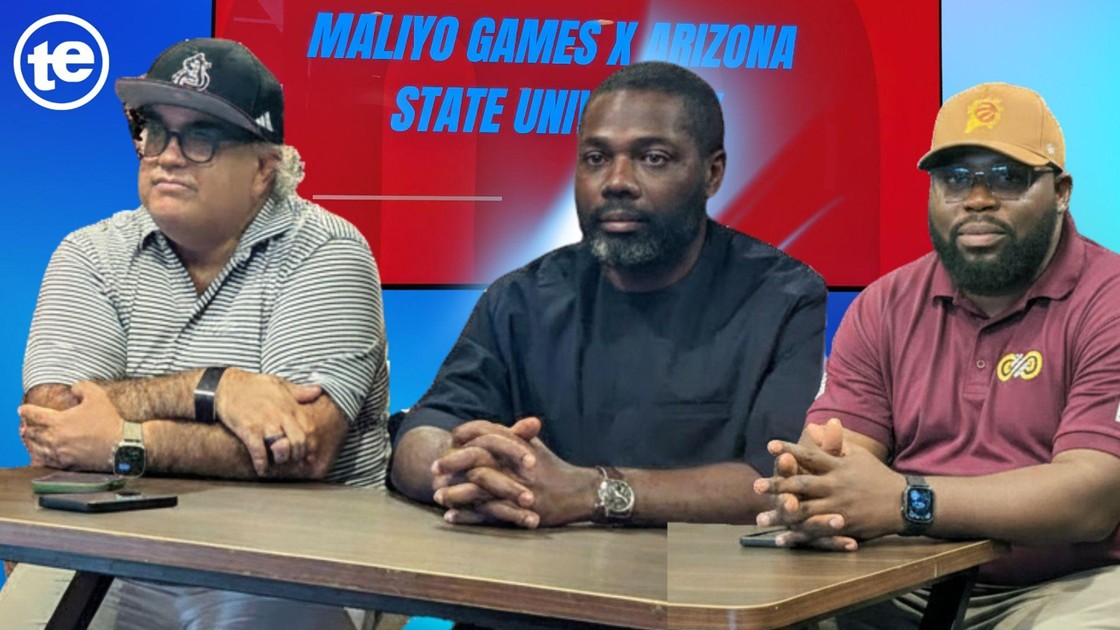 L-r: Mark Olilla, founding director, Endless Games and Learning Lab, Arizona State University; Hugo Obi, CEO, Maliyo Games, and Bola Akinrolabu, assistant director, Endless Games and Learning Lab, Arizona State University, during a media interaction to discuss the partnership between Maliyo games and Arizona State University, held in Lagos.
Techeconomy’s Oluwatosin Aloba has a chat with Mark and Bola:
Institutional Strategy
Te: What motivated Arizona State University to partner with a Nigerian gaming company like Maliyo Games?
Mark Olilla: We look for partners already creating impact. Maliyo has proven experience in both training and industry delivery, which makes them ideal.
Te: How does this initiative fit into ASU’s global strategy around experiential learning and digital innovation?
Mark: Our focus is on flexible learning pathways. People learn differently depending on their environment. Someone may learn better through games than through textbooks, and we want to support that. Games are one of the most complex forms of creation. When you learn to build games, you’re learning storytelling, programming, design, teamwork, and problem-solving skills that apply to any industry.
The model works as:
- Play to Learn → Recognising skills gained through gaming
- Make to Learn → Building real products (games, tools, experiences)
- Earn to Learn → Turning skills into income and careers
He emphasised that this model is designed to be scalable, accessible, and affordable.
Micro-Credentials: A New Kind of Qualification
Te: Why are microcredentials central to this programme?
Mark: They validate real skills especially when someone has actually built something.
Te: How will these credentials be structured to ensure global relevance and employability?
Bola Akinrolabu: Arizona State University is globally recognised, with over 180,000 students and a presence across multiple regions. A microcredential from Arizona State University provides strong validation that the learner has completed a rigorous, practical programme.
Empowering African Talent
Te: What unique advantages does Nigeria offer in the global gaming and creative economy?
Bola: Nigeria’s massive youth population and creative energy make it a strategic starting point. Also, as someone born and raised in Nigeria, I find this personal. This partnership is about opening alternative pathways to education and empowering young people to become self-reliant. This is about giving young people the ability to build careers, create companies, and shape their future.
Experiential Learning Model
Te: How will this programme deliver real-world learning?
Mark: We focus on collaboration and building. When people work together and create, that’s where real learning happens. Seeing students mentor each other and build projects, that’s exactly the ecosystem we want.
Programme Structure & Intensity
Te: Is five to six months enough for learning?
Bola: Yes. This model is proven. The intensity helps people learn in months what might take years in traditional systems. We’ve seen beginners create playable games in just days; the pressure accelerates learning.
Challenges & Execution
Te: What challenges have you encountered so far?
Bola: We’re still in the planning stage, but infrastructure such as Power supply, Hardware access, and internet connectivity is something we’re mindful of. However, the team is already working on solutions, including: Physical learning hubs with access to tools and equipment. We see it not as a barrier, but a problem we’re already working to solve.
Measuring Success & Mentorship
Te: What metrics will ASU use to measure the success of this programme? Will there be mentorship beyond the programme?
Bola: Participants must create an artefact, a working project. That’s proof of learning. The microcredential validates that they’ve completed the process. Yes, peer-to-peer mentorship is key. People who have gone through the programme come back to guide others.
Scaling & Long-Term Impact
Te: In five years, what impact would you like to see this partnership have on both Nigerian and global talent ecosystems?
Mark: We want to reach hundreds of thousands, even millions, giving people the tools to learn, create, and earn.
Bola: Ultimately, we want to see young people empowered, building careers and contributing to both Nigeria’s and the global digital economy.
This partnership signals a shift in how education, skills, and opportunity are built and validated in Africa’s digital economy. It could redefine Africa’s role in the global gaming and AI ecosystem.
Continue Reading from >>> here.
The post Mark Olilla | Bola Akinrolabu: Gaming is a Creative Way to Redefine Education for Millions in Africa appeared first on Tech | Business | Economy.