
 1 hour ago
1
1 hour ago
1
ARTICLE AD BOX
Nigeria’s telecommunications sector closed the 2025 financial year on a high note, recording robust growth in its contribution to the nation’s Gross Domestic Product (GDP).
According to data published by the National Bureau of Statistics (NBS) and corroborated by the Nigerian Communications Commission (NCC) Industry Statistics, the sector posted 8.12% of real GDP in Q4 2025, representing a year-on-year (YoY) increase from the comparable figure of 7.29% recorded under the rebased GDP framework in Q4 2024.
This amounts to a YoY percentage-point increase of approximately 0.83 percentage points, translating to a percentage increase of roughly 11.4%.
On a full-year basis, the telecom sector contributed 8.3% to Nigeria’s real GDP in 2025 compared to 8.1% in 2024, while in absolute nominal terms, the sector’s GDP contribution surged from N17.2 trillion in 2024 to N18.5 trillion in 2025, a nominal increase of N1.3 trillion.
The sector’s real growth rate in Q4 2025 stood at an impressive 26.34% year-on-year, an acceleration of 8.37 percentage points over the 17.97% recorded in Q4 2024.
These figures underscore the centrality of telecommunications to Nigeria’s economic architecture, positioning the sector as the fourth-largest contributor to real GDP, trailing only crop production, trade, and real estate.
This report analyses the data in full, examines the drivers behind the performance, and explores the broader economic implications for Nigeria’s digital economy.
Key Statistics at a Glance
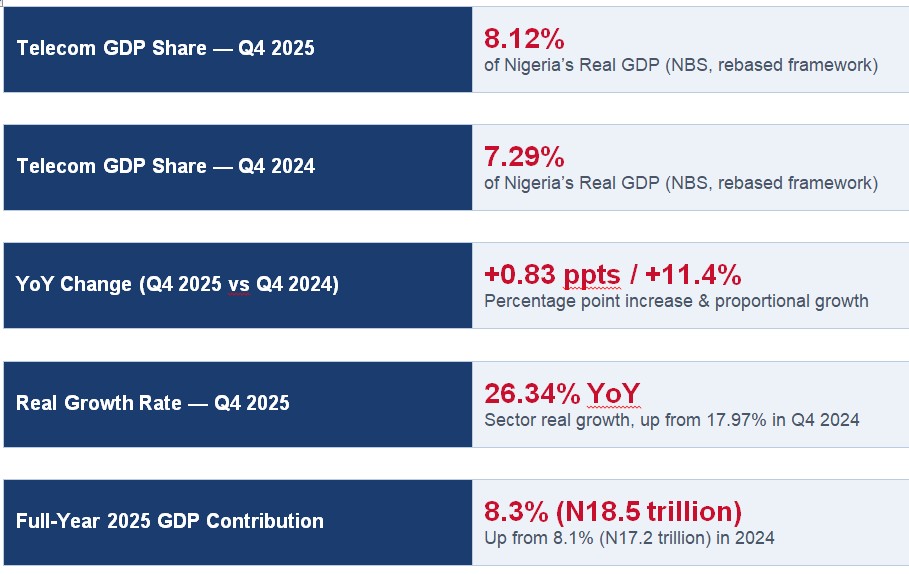 Telecom contibution to GDP Q4 2025 | Sources: NCC/NBS
NOTICE: Nigeria’s NBS rebased its GDP in 2025, adopting a new base year and incorporating additional sectors and activities. Under the pre-rebasing framework (used up to 2024 reporting), telecoms contributed 14.40% to GDP in Q4 2024. Under the new rebased framework, the same Q4 2024 figure is expressed as approximately 7.29% (Telecoms & Information Services sub-sector). For consistency, this report uses post-rebasing figures (8.12% vs 7.29%) for the primary YoY comparison. Where pre-rebasing figures are cited, they are clearly labelled. Both datasets confirm the same directional truth: the sector grew.
The Data: Quarterly GDP Performance
Q4 2025 – Telecom GDP Contribution
In Q4 2025, Nigeria’s telecommunications and information services sub-sector contributed 8.12% to the nation’s real GDP, according to the NBS Q4 2025 GDP Report released on 27 February 2026. This places telecommunications as the fourth-largest contributor to Nigeria’s real GDP during the quarter, behind crop production (20.44%), trade (16.84%), and real estate (14.57%).
The sector’s Q4 2025 real GDP growth rate stood at 26.34% year-on-year, which was 8.37 percentage points above the 17.97% recorded in Q4 2024.
Quarter-on-quarter, it was 5.46 percentage points above the preceding quarter (Q3 2025), reflecting a strong acceleration into the year-end. Nigeria’s nominal GDP for Q4 2025 rose to N122.81 trillion, up 17.55% year-on-year from N104.48 trillion in Q4 2024.
Q4 2024 – Baseline Period
In Q4 2024, the telecom sub-sector contributed 14.40% to real GDP under the pre-rebasing framework (the figure widely cited by NCC and NBS at the time), or 7.29% under the post-rebased comparable measure.
The sector’s growth rate was 17.97% in Q4 2024, already signalling strong momentum, while the broader ICT sector contributed 17.00% (pre-rebasing) to real GDP.
Nigeria’s real GDP grew 3.84% in Q4 2024, driven primarily by the services sector. Telecommunications ranked as the third-largest contributor to real GDP in that quarter, behind crop production (23.42%) and trade (15.11%).
Year-on-Year Comparison Table
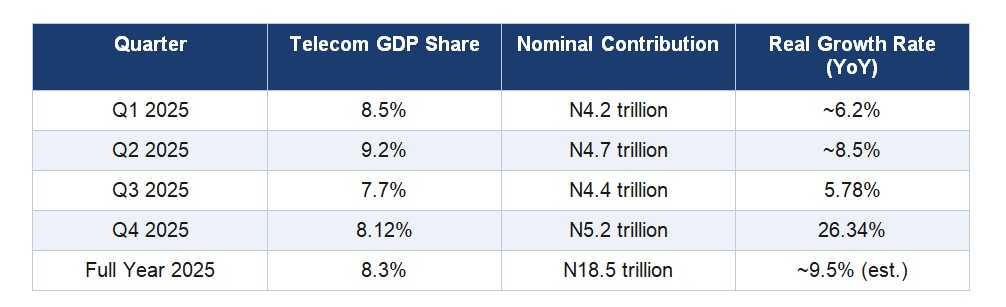 Telecom contibution to GDP Q4 2025 | Source: NCC/NBS
Drivers of Q4 2025 Growth
| Infrastructure Investment Boom
A defining feature of 2025 was the unprecedented scale of infrastructure spending by Nigeria’s telecom operators.
The NCC disclosed that operators collectively added approximately 2,800 new towers during the year and committed more than $1 billion to fibre-optic rollout and network upgrades across the country.
MTN Nigeria more than doubled its capital expenditure to N1 trillion in 2025, compared to N443.5 billion in 2024, accelerating modernisation of its radio and core networks, and launching its Tier III Dabengwa Data Centre in Lagos.
Airtel Nigeria secured a Direct-to-Cell partnership with Starlink and more than doubled the number of active 5G sites.
It reported a 52.2% year-on-year revenue surge to $1.13 billion for the nine months ending December 2025.
Globacom deployed new base stations, expanded its backbone, and rolled out hybrid battery power systems at numerous sites.
| Data and Subscriber Growth
Nigeria’s active telecom subscriptions rose from approximately 164.9 million in December 2024 to 179.6 million by December 2025, an addition of roughly 14.7 million subscribers in a single year. Broadband penetration crossed the 50% mark, ending 2025 at 51.97%, compared to approximately 45% at end-2024.
Data consumption surged dramatically: 148 million Nigerian internet users consumed approximately 1.4 million terabytes of data in December 2025 alone, illustrating the deepening reliance on digital services for commerce, entertainment, and financial transactions.
In the first quarter of 2026, Nigerians spent N3.33 trillion on data, an indication of the continuing trajectory.
| Tariff Adjustment Impact
The NCC approved a 50% average tariff adjustment in early 2025, the first such increase in over a decade, following sustained pressure from operators citing rising costs from currency depreciation and energy price inflation.
While consumer groups raised concerns, the adjustment contributed directly to higher nominal revenue for operators, boosting the sector’s GDP contribution in naira terms.
| 5G Expansion
The year saw notable acceleration in 5G network rollout. MTN and Airtel both significantly expanded their 5G footprints, while the NCC provided regulatory support through spectrum management and right-of-way facilitation.
The percentage of subscribers on 5G networks rose from 2.46% in December 2024 to 3.77% by December 2025, with Q1 2026 showing further acceleration to 4.20%.
Quarterly Trend: Full 2025 Picture
To contextualise Q4 2025, it is instructive to review the entire 2025 performance trajectory across all four quarters:
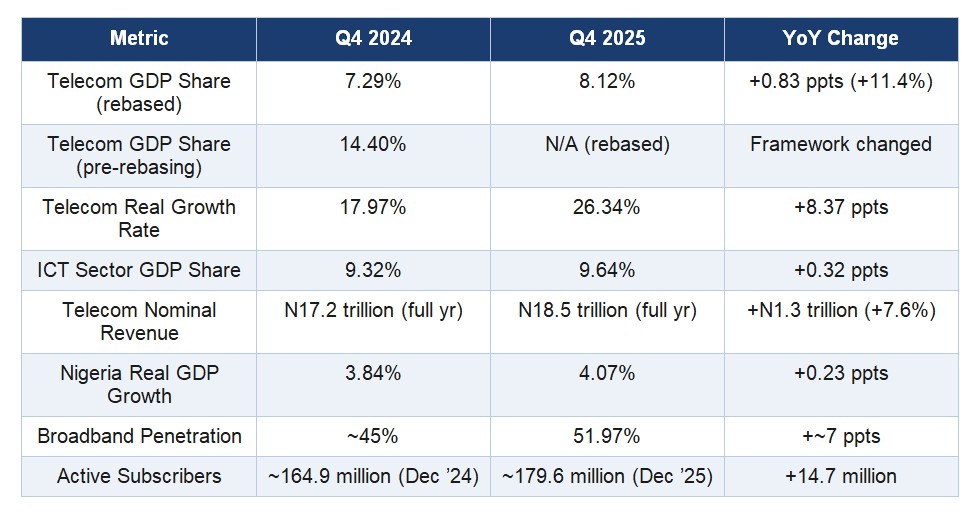 Telecom contibution to GDP Q4 2025 | Sources: NCC/NBS
Q4 2025 recorded the highest nominal quarterly contribution (N5.2 trillion) and the highest real growth rate (26.34% YoY) of the year.
The dip in Q3 reflected seasonal patterns and temporary infrastructure pressures, but the year-end surge demonstrates the resilience of the sector and the compounding effects of investments made earlier in the year.
Economic Implications
Digital Economy as Growth Engine
Telecommunications no longer functions merely as a utility sector, it has become a structural engine of Nigeria’s economic growth. Its role as the backbone of fintech, e-commerce, and digital government services means that each percentage point of telecom growth generates multiplier effects across the broader economy.
The financial and insurance sector, which grew 27.78% in Q4 2024 and remains one of the fastest-growing sectors, is deeply dependent on telecom infrastructure for mobile money, digital banking, and payment processing.
Employment and SME Ecosystem
The expansion of broadband infrastructure and digital services has created direct and indirect employment across Nigeria’s 36 states. Mobile internet access enables micro-enterprises, market traders, artisans, and freelancers to access digital payment platforms, online marketplaces, and e-government services. The NCC’s rural broadband initiative through the Universal Service Provision Fund (USPF) has extended connectivity to underserved areas, progressively drawing more Nigerians into the formal digital economy.
Foreign Direct Investment Signal
The strong Q4 2025 telecom performance coincides with growing investor interest in Nigeria’s digital sector. Analysts project an 8% compound annual growth rate (CAGR) for Nigeria’s telecom sector through 2028.
The NCC under Executive Vice Chairman, Dr. Aminu Maida has championed a regulatory environment designed to be merit-based, investor-friendly, and focused on transparency.
This has attracted renewed scrutiny from sovereign wealth funds and private equity investors eyeing Nigeria’s digital infrastructure as a long-term asset class.
The Path to 25% GDP Contribution
The NCC and the Federal Ministry of Communications, Innovation and Digital Economy have set an ambitious target: raising the telecom sector’s contribution to 25% of GDP.
While the current 8.12% (rebased) figure may appear distant from that goal, it is critical to note that under the pre-rebasing framework, the sector was already contributing approximately 14.4% to GDP in Q4 2024.
The 25% target, once contextualised within the pre-rebasing GDP framework and accounting for sector expansion, is achievable within a decade if current investment and subscriber growth trends are sustained.
Key milestones required to achieve the 25% target include:
- Full national fibre-optic backbone completion (Project Bridge: 90,000 km target)
- Right-of-way harmonisation across all 36 states to reduce fibre deployment costs
- 5G commercial rollout in all major urban centres by 2027
- Digital literacy programmes to convert the remaining ~50% non-internet-using population
- Regulatory frameworks for emerging technologies: AI, IoT, cloud computing, and satellite internet
Currency and Macroeconomic Headwinds
Despite the impressive growth figures, Nigeria’s telecom sector continues to face macroeconomic headwinds.
The persistent depreciation of the naira, which increased the cost of imported network equipment and dollar-denominated debt servicing, contributed to significant losses for key operators in 2024, including MTN Nigeria’s reported N400 billion loss.
The tariff increase approved by the NCC in early 2025 partially addressed this imbalance, but operators warn that further naira depreciation could erode profitability gains and slow future investment cycles.
Additionally, energy costs remain a significant burden, with many operators running diesel generators due to the unreliable national grid. The transition to renewable energy-powered base stations is ongoing but capital-intensive.
NCC Regulatory Framework & Data Methodology
The statistics underpinning this report are drawn from the NCC Industry Statistics portal, published pursuant to Section 89(3)(d) of the Nigerian Communications Act 2003 (NCA 2003), which mandates the Commission to monitor, report on, and provide statistical analyses of the Nigerian telecommunications industry.
The GDP contribution figures are sourced from the National Bureau of Statistics (NBS) quarterly GDP reports.
Under the NBS methodology, the ICT sector comprises four sub-activities: (1) Telecommunications and Information Services; (2) Publishing; (3) Motion Picture, Sound Recording and Music Production; and (4) Broadcasting. Telecommunications and Information Services consistently accounts for the dominant share, approximately 7.29% of GDP in Q4 2024 and 8.12% in Q4 2025 under the rebased framework.
Industry Perspective
“Telecommunication is the biggest beneficiary of the accelerating use of digital technology in financial services, media, entertainment, and renewable energy. The numbers we are seeing in Q4 2025 reflect years of investment now bearing fruit.”— Olu Akanmu, former CEO of OPay and former CMO of Airtel Nigeria
Regulatory Perspective
“The sector has done well with its contribution to GDP, but it can do better. We are working on the right policies to push the contribution of the telecom sector to 25%.”— Dr. Aminu Maida, executive vice chairman, Nigerian Communications Commission (NCC).
In essence…
The Q4 2025 data confirms that Nigeria’s telecommunications sector is on a strong and accelerating growth trajectory.
The sector’s contribution to real GDP rose from 7.29% in Q4 2024 to 8.12% in Q4 2025, representing a year-on-year increase of 0.83 percentage points or approximately 11.4% proportional growth. The sector’s real growth rate surged to 26.34% in Q4 2025, its highest quarterly rate in recent years.
Behind these numbers lies a story of deliberate policy, significant capital investment, and growing consumer demand for digital connectivity.
As Nigeria pushes toward the ambitious 25% GDP contribution target, the telecom sector will need sustained regulatory support, continued infrastructure investment, and targeted policies that address the structural barriers of energy costs, currency risk, and right-of-way access.
What the Q4 2025 figures make unmistakably clear is this: in an economy navigating inflation, currency pressures, and structural reform, telecommunications has emerged as one of the most reliable and strategically significant pillars of Nigeria’s national development agenda.
The post NCC: Telecom GDP Contribution Hits 8.12% in Q4 2025 appeared first on Tech | Business | Economy.












 English (US) ·