
 2 hours ago
3
2 hours ago
3
Starlink has stopped accepting new customers in seven Kenyan counties after demand outstripped available network capacity, a sign of the strains facing the satellite internet provider as it expands faster than its infrastructure can support.
New customers in Nairobi, Kiambu, Mombasa, Machakos, Murang’a, Kirinyaga, and Kwale are now redirected to a waiting list instead of being allowed to complete orders.
“Starlink service is currently at capacity in your area,” the company tells customers attempting to subscribe. “You can still place a deposit now to reserve your spot on the waitlist. We cannot provide an estimated timeframe for service availability, but our teams are working as quickly as possible to add more capacity.”
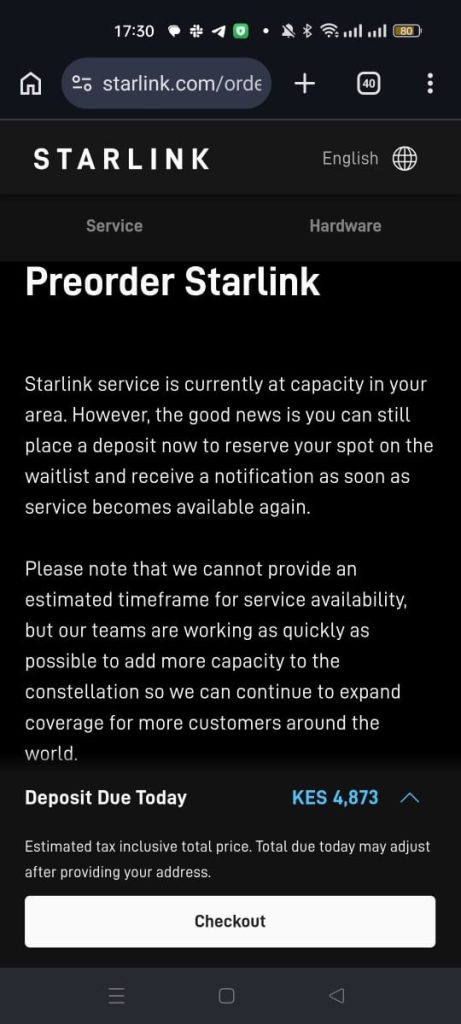 Screenshot showing a Starlink message informing a customer that the service is at capacity in Kenya.
 The waiting lists suggest that demand in some of Kenya’s largest population centres has overtaken the network capacity that the company has allocated to the country, presenting Starlink with a new challenge as it seeks to sustain its growth.
The suspension comes after a year of rapid subscriber growth fuelled by lower equipment prices and cheaper service plans. Communications Authority (CA) data shows Starlink had 24,999 subscribers at the end of March, more than three times the 8,063 customers it reported nine months earlier.
Although that represents less than 1% of Kenya’s fixed internet market, it is one of the fastest growth rates among licenced internet service providers.
The company has steadily reduced the cost of joining its network since launching in Kenya in July 2023. Hardware that initially cost KES 89,000 ($688.8) now sells for KES 49,900 ($386), while customers can rent the equipment for KES 1,950 ($15) monthly instead of buying it outright. It has also introduced lower-priced broadband packages, including a 50GB monthly plan costing KES 1,300 ($10), widening its appeal beyond affluent early adopters.
Those price cuts have helped Starlink gain customers in rural areas where fibre networks remain scarce, while also attracting households and small businesses in cities looking for an alternative to terrestrial broadband providers.
True scale demands moving beyond surface-level integrations to robust execution. We’ve filtered the noise out of Moonshot 2026, optimising the conference strictly for high-calibre connections between startup founders, global financial operators, enterprise leaders and individuals rewiring Africa’s technical frameworks.
Get 20% off Early Bird tickets for a limited time.













 English (US) ·