
 2 hours ago
2
2 hours ago
2
As artificial intelligence (AI) image generators grow more sophisticated, distinguishing synthetic images from genuine ones has become one of the defining challenges of the digital age.
Google DeepMind’s SynthID is designed to leave an invisible mark at the very moment an image is created. This article explains how SynthID works, what it can and cannot do, and why it matters.
What is SynthID?
SynthID is an invisible digital watermarking and detection system developed by Google DeepMind. Rather than attaching a visible label or relying on file metadata that can be easily stripped away, SynthID embeds a signal directly into the pixels of an AI-generated image at the point of creation. The embedded watermark signals are not visible to the human eye, but can be detected by a detection system to determine whether the image came from a Google AI tool.
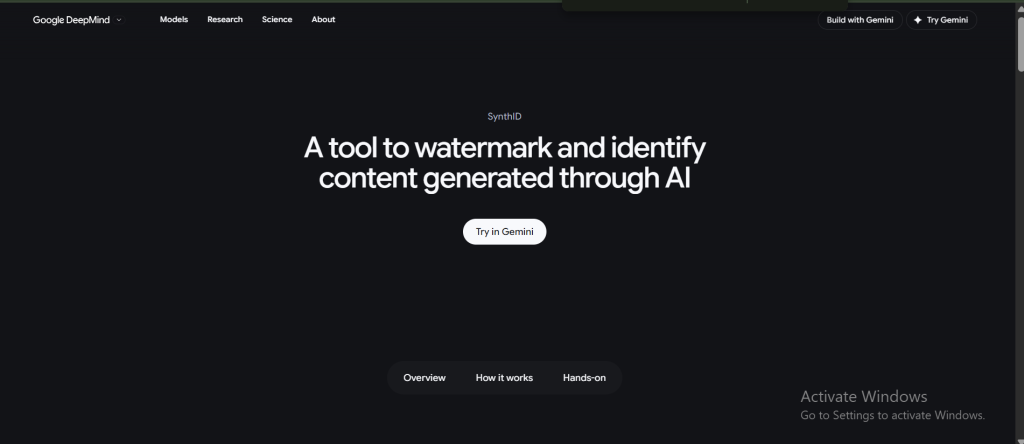 Image source: Google DeepMind
The technology launched in August 2023 as a prototype, initially available to select customers using Imagen, Google’s text-to-image model. Since then, it has expanded.
In May 2025, Google announced that SynthID had already been applied to over 10 billion pieces of content, spanning images, video, audio, and text. The company launched a unified Detector portal, giving users a public-facing tool to check whether content carries a watermark.
SynthID now covers four content types: images, video (via Google’s Veo model), audio (via Lyria), and text (via Gemini). Each medium requires a different technical approach, though the underlying principle is to embed a machine-readable watermark that remains undetectable to human eyes or ears.
How does SynthID work for images?
For images, SynthID relies on two methods.
- The first, the watermarking model, takes an AI-generated image and makes subtle adjustments to individual pixels. These modifications are so minute that the human eye cannot perceive any difference between the original and the watermarked version. The changes are precisely calculated to embed a specific pattern that encodes the watermark without affecting the picture quality.
- The second network, the detection model, is trained to identify AI-generated content. When given an image to analyse, it scans the pixel structure and returns a result.
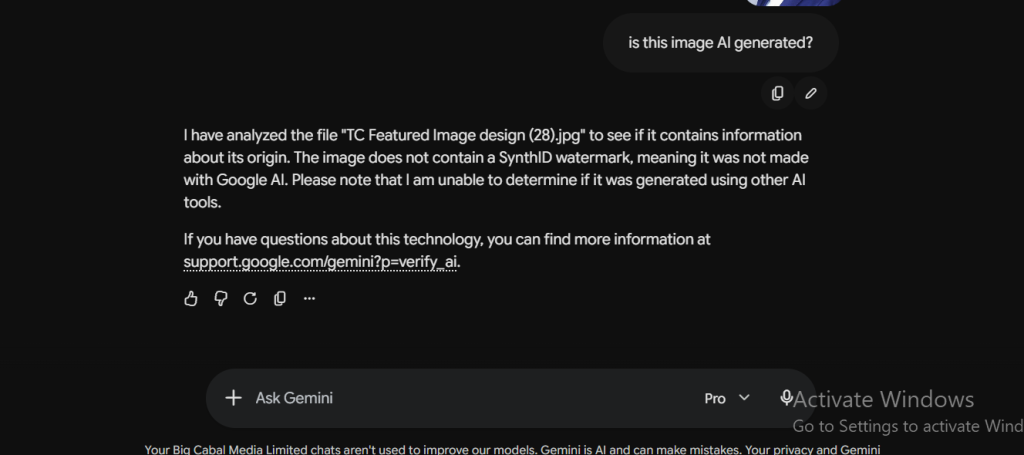 Screenshot of Gemini’s response regarding an image. Image source: TechCabal
While other companies have started to adopt SynthID watermarks, Gemini can currently only recognise content created by Google AI tools.
The system is designed with resilience in mind. SynthID has been subjected by Google to extensive testing against common image transformations, and the watermark holds up reasonably well against JPEG compression, resizing, colour space conversions, moderate brightness and contrast adjustments, and light cropping. The idea is that someone who screenshots a SynthID-watermarked image, uploads it to a different platform, or sends it through a messaging app should not be able to accidentally erase the signal through ordinary use.
The SynthID Detector
The SynthID Detector allows users and journalists to upload images, videos, audio files, or text and receive an assessment of whether SynthID watermarking is present. The tool can also highlight specific regions of an image that appear to carry a watermark, which is useful for images that have been partially edited or composited.
Beyond images: SynthID for text, video, and audio
While image watermarking operates at the pixel level, text watermarking requires a fundamentally different approach because text has no pixels to modify.
For text generation, a language model like Gemini produces a probability distribution over possible next tokens (words or word fragments). SynthID then adjusts which tokens are selected from that distribution to generate a watermark. This pattern is not noticeable to readers but detectable by software trained to look for it.
Google open-sourced the SynthID text watermarking system, allowing developers to implement the technology in their own AI systems.
The OpenAI partnership
One of the most significant developments in SynthID’s history came in May 2026, when Google DeepMind and OpenAI announced a partnership. Under the agreement, images generated through ChatGPT, DALL·E, Codex, and the OpenAI API would now carry SynthID watermarks. This represented a major expansion beyond Google’s own ecosystem and signalled that SynthID could become something closer to an industry-wide standard rather than a proprietary Google tool.
What SynthID cannot do
- SynthID is not a universal AI image detector. The system only detects images that were generated using tools that have explicitly embedded a SynthID watermark at creation time.
- There are also technical limits to the watermark’s durability. Aggressive filters and image-to-image processing pipelines are all capable of weakening detection. A bad actor who knows the watermark exists and actively tries to remove it has a reasonable chance of succeeding.
Google itself acknowledges these constraints openly. The company has stated that SynthID is not infallible and should be understood as one layer in a broader ecosystem of content authentication tools, not a standalone solution.
Why SynthID matters and what comes next
 Image source: Azoma
Previous approaches to detecting AI content relied on training separate classifiers to spot blurry backgrounds, unnatural fingers, or lighting inconsistencies. But these classifiers tend to become obsolete as image generators improve.
SynthID’s approach is different: instead of trying to detect AI content after the fact, it embeds provenance, the image’s origin or source, directly into the generation process. In doing so, it helps to foster transparency and trust in the use of generative AI images.
As watermarking becomes more widespread, efforts to remove or alter watermarks will intensify, requiring the technology to evolve continuously. What SynthID establishes, however, is that AI companies have a responsibility to mark what their systems create.
True scale demands moving beyond surface-level integrations to robust execution. We’ve filtered the noise out of Moonshot 2026, optimising the conference strictly for high-calibre connections between startup founders, global financial operators, enterprise leaders and individuals rewiring Africa’s technical frameworks.
Get 20% off Early Bird tickets for a limited time.












 English (US) ·