
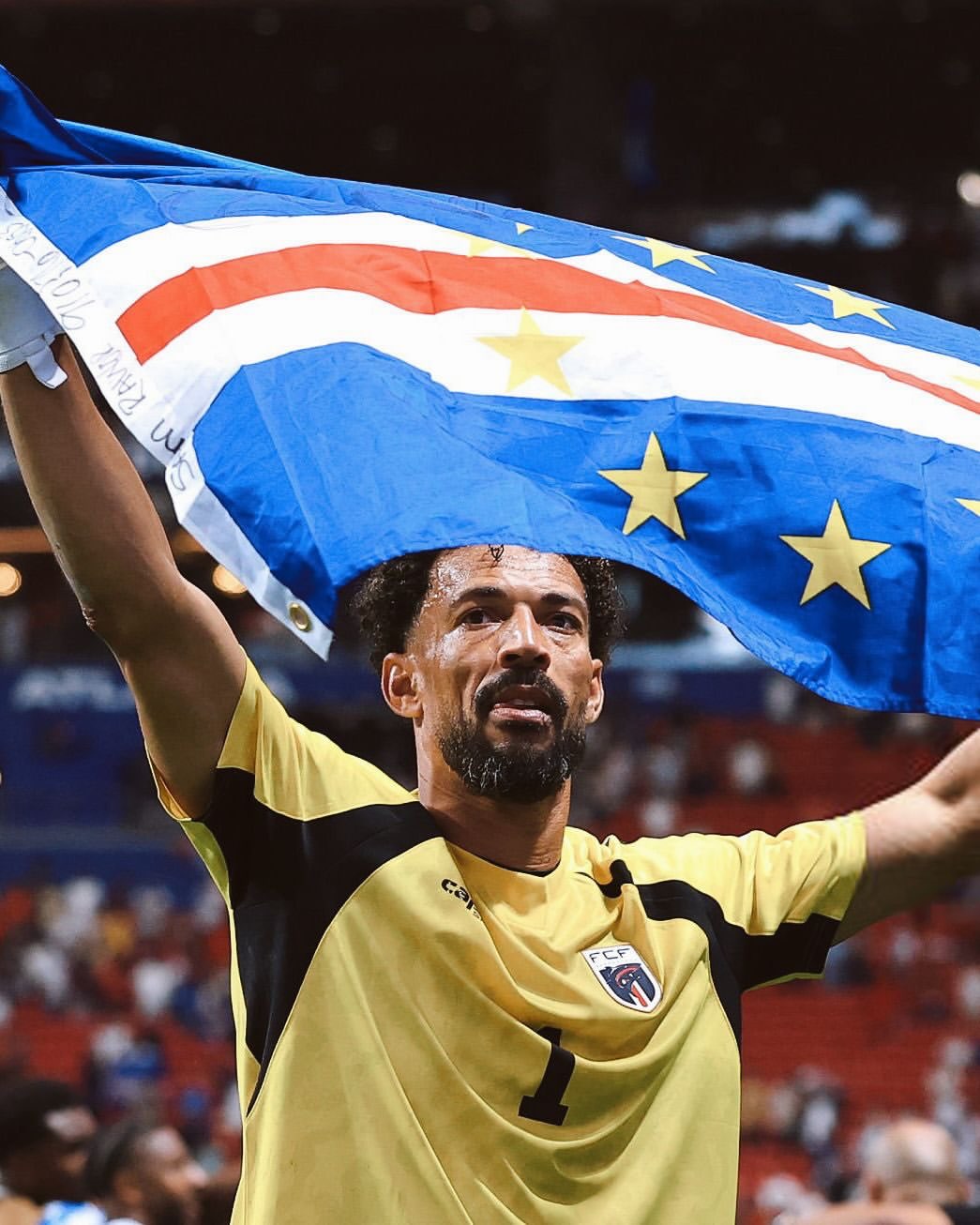
Vozinha raises the Cape Verdean flag after a match. Photo credit: Vozinha/Instagram
Since the establishment of the FIFA World Cup, no African country has lifted the football’s most coveted trophy. While the continent has produced some of the most gifted footballers in the world—JayJay Okocha, George Weah, Didier Drogba, Samuel Eto’o, Yaya Touré, Mohamed Salah, Sadio Mané, Victor Osimhen and countless others—the World Cup has remained beyond its reach.
Although a few African countries have strived to bring the trophy home, the dream is yet to come true. Cameroon reached the quarter-finals in 1990 to become the first African team to reach the quarter-finals. Then came Morocco’s historic run in 2022 to become the first African country to reach the World Cup semi-finals. These strides are important to highlight because the more an African country progresses in the tournament, the more African countries are included. When Cameroon reached the quarter-finals in 1990, more spaces were created for Africa; likewise, when Morocco reached the semi-finals, which is why we have more African countries at the World Cup in 2026.
Now, as African teams continue to challenge some of football’s traditional heavyweights at the 2026 World Cup, it is right to ask whether African countries finally have a chance to lift the World Cup. So far, at the time of writing, two African countries, Morocco and Egypt, have reached the Round of 16, defeating and drawing some of the tournament’s giants. All these indicate that African teams are striving to rewrite history and lift the trophy for the continent.
But before we ask whether an African country has a chance of lifting the World Cup, we should start instead by asking if Africa is ready to build the institutions to enable the dream to come true.
It is tempting to explain Africa’s record at the World Cup by pointing to the quality of opposition. After all, every World Cup winner has come from Europe or South America. But that explanation ignores the fact that a lack of talent has rarely defeated Africa. The continent has produced some of the best footballers in the world; a Ballon d’Or winner, even.
African football rather has been undermined by its own football structures. Too many African football federations have spent decades wrestling with administrative crises instead of preparing for tournaments. You hear stories of unpaid bonuses, player strikes, chaotic travel arrangements and political interference, and that’s the difference when compared with football federations of other countries that build football administrations for a long-term project.
Winning the World Cup demands much more than producing exceptional footballers. It requires stable institutions that make players proud to represent their countries. It requires elite academies, modern coaching, data analysis, medical support and a strong football philosophy. Those are the foundations upon which France, Germany, Spain and others have built sustained success.
Africa has often arrived at the World Cup with extraordinary players but ordinary institutions. That reality helps explain why so many gifted generations failed to fulfil the World Cup promise, because, of course, every country leaves home to win. For instance, Nigeria’s immensely talented squads never quite translated potential into consistency.
However, the 2026 World Cup is showing that something is beginning to change. Many African countries are adopting strategies to actualise the dream.
Take, for example, Morocco’s journey to the semi-finals in Qatar, which can be considered a culmination of years of deliberate investment, and not simply a product of an inspired coach or an exceptional group of players. The country’s football federation modernised its structures, invested heavily in youth development, improved coaching standards and, importantly, began integrating players from its vast diaspora into a cohesive national identity.
Other African nations have begun following similar paths.
The Democratic Republic of Congo has reconnected with players born and developed in Europe but eligible through family heritage. Algeria and Senegal are benefiting from similar strategies, persuading dual-nationality players that representing their ancestral homes is no longer merely a second decision or choice. At the current World Cup, France has 99 French-born players playing at the tournament, but not all play for France. 13 play for Algeria, 11 for DR Congo, 10 for Senegal, 8 for Ivory Coast, and others. African countries are integrating Europe-born players into their squads because, one, they are developed in a proper football institution and two, they are simply so good.
They make many players who once viewed African national teams as a second option as ambitious football projects capable of competing with the world’s best. The results are beginning to show. Africa’s record representation at the 2026 World Cup has been matched by an unprecedented collective performance, with nine of the continent’s ten representatives progressing to the knockout rounds.
This does not guarantee that an African country will win the World Cup anytime soon, but it can happen in the near future if continuous effort is put into the football institutions. This means thinking beyond the next Africa Cup of Nations or the next World Cup qualification campaign, and adopting the mentality that they can simply defeat any country, no matter its intimidating history. As Morocco defeated Portugal in Qatar in 2022, other African countries should also believe they can defeat Germany o, Brazil o, Argentina o, any country.
May we all be alive when an African country eventually lifts the trophy.
The post What Will It Take for an African Country to Win the World Cup? appeared first on BellaNaija - Showcasing Africa to the world. Read today!.









 English (US) ·