
 1 hour ago
1
1 hour ago
1
ARTICLE AD BOX
Growth momentum strengthened in the Nigerian private sector during May. Marked rises in output and new orders were recorded, with firms ramping up their purchasing accordingly.
Expansions in employment remained muted, however, on the price front, higher fuel costs continued to cause sharp increases in input costs and output prices, but rates of inflation softened from April.
The headline figure derived from the survey is the Stanbic IBTC Purchasing Managers’ Index (PMI).
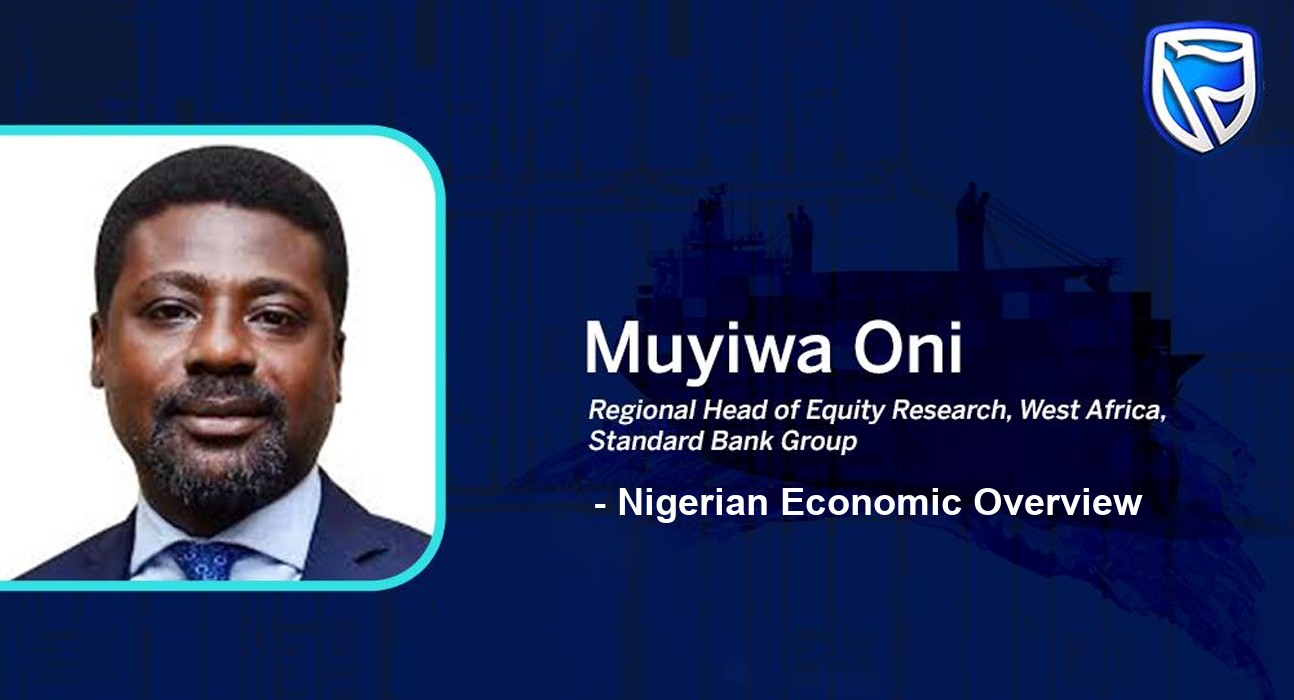 Muyiwa Oni, Stanbic IBTC Bank
Readings above 50.0 signal an improvement in business conditions on the previous month, while readings below 50.0 show a deterioration.
Muyiwa Oni, head of Equity Research West Africa at Stanbic IBTC Bank commented:
“Private sector activity in Nigeria improved to its best level in nine months, with the headline PMI rising to an impressive 54.1 points in May from 52.4 points in April.
This impressive business condition was primarily due to accelerated expansion in both output (56.6 vs April: 53.4) and new orders (57.0 vs May: 54.6) as evidence pointed to improving customer demand and the launch of new products.
Input prices maintained an uptrend, but the pace of increase eased for the second consecutive month. This is also reflected in higher output prices with the steepest increase seen in the manufacturing and agriculture sectors.
According to the National Bureau of Statistics (NBS), the Nigerian economy grew by 3.89% y/y in Q1:26, slightly below estimate of 3.99% y/y GDP growth rate for the quarter as implied by the Stanbic IBTC Bank PMI, with the deviation stemming from lower-than-expected non-oil sector’s growth performance.
Continuining, Mr. Oni said:
The oil sector grew by a modest 2.57% y/y (vs Q4:25: 6.79% y/y) while the non-oil sector’s growth also slowed to 3.94% y/y from 3.99% y/y in Q4:25.
The breakdown of the 19 different sectors that make up the domestic economy shows the agriculture; manufacturing; construction; information & communication; trade; and finance & insurance as the biggest drivers of Nigeria’s GDP growth in Q1:26. These sectors accounted for 82.4% of real GDP growth rate during the quarter.
Given the lower-than-projected real GDP growth in Q1:26, the economy may now well grow by 4.13% y/y in 2026 from our initial forecast of 4.22% y/y, and 3.87% y/y in 2025. Electioneering activity; continuous government investment attraction drive; and improved spending on infrastructure should continue to keep the non-oil sector active during the year.
Meanwhile, we retain our expectation that crude oil production will likely average 1.7m bpd in 2026 from 1.64m bpd recorded in 2025 and we do not see production touching the 2.0m bpd psychological benchmark until at least 2030.”
The headline PMI rose to 54.1 in May from 52.4 in April, signalling a solid monthly improvement in business conditions and one that was the most pronounced since August 2025. The health of the private sector has now strengthened in four consecutive months.
Central to the solid improvement in business conditions were marked and accelerated expansions in both output and new orders during May. Rates of growth hit seven- and nine-month highs respectively. Anecdotal evidence pointed to improving customer demand and the launch of new products.
Output growth was recorded across all four broad sectors covered by the survey. Improving demand, and the prospect of further growth in the months ahead, led companies to expand their purchasing activity and inventories in May. Here too, rates of expansion quickened from April and were sharp.
Efforts to secure inputs were helped by an improvement in vendor performance, as prompt payments, goods arrangements with suppliers and better road conditions helped to speed up deliveries.
Employment continued to rise only slightly midway through the second quarter, although sustained job creation has now been recorded in each month for a year.
Meanwhile, backlogs of work increased for the fourth successive month amid customer payment delays, material shortages and power failures.
Increasing fuel costs following the outbreak of war in the Middle East continued to drive up purchase prices in May.
Purchase costs rose rapidly again, despite the rate of inflation easing to a three-month low. Purchase prices increased at a much quicker pace than staff costs, which rose modestly again in May.
Where companies increased staff pay, this was often to provide help with higher living costs, and those for transportation in particular. In line with the picture for input costs, output prices continued to rise sharply in May.
Here too, however, the rate of inflation eased to the lowest since February. Plans to increase advertising and expand operations through the opening of new branches and introduction of new products were behind optimism in the year-ahead outlook for output. Sentiment dipped, however, and was the lowest for a year.
Experts have linked Nigeria’s decline in air travel activity to weakening consumer demand caused by higher ticket prices following recent tax adjustments and increased operational costs facing domestic airlines.
Nigeria’s economy posted stronger growth in the first quarter of 2026, with the services sector, telecommunications, finance, transportation and construction emerging as the key pillars supporting the country’s gradual economic recovery amid persistent inflationary pressures and elevated interest rates.
Fresh analysis of the latest national accounts released by the National Bureau of Statistics (NBS) showed that the economy expanded by 3.89 percent year-on-year in Q1 2026, an improvement from the 3.13 percent recorded in the corresponding period of 2025.
The performance reflects improving business activity across critical non-oil sectors and a modest rebound in oil sector output, reinforcing expectations that Nigeria may sustain stronger economic momentum through the rest of the year.
However, the aviation segment remained under pressure, as air transportation contracted by 7.62 percent year-on-year, worsening from the 0.81 percent contraction recorded in Q1 2025.
The latest data indicate that the non-oil sector remained the dominant driver of growth, accounting for about 96 percent of total economic output during the quarter. Non-oil GDP grew by 3.94 percent year-on-year, slightly higher than the 3.31 percent recorded in Q1 2025.
Oil sector growth also improved to 2.57 percent from 1.97 percent a year earlier, supported by improved production levels and firmer crude oil prices.
Sectoral analysis showed that services remained the strongest-performing broad sector of the economy, expanding by 4.31 percent year-on-year, ahead of industry at 3.50 percent and agriculture at 3.15 percent.
Within the services sector, information and communications retained its position as Nigeria’s fastest-growing major economic activity, recording a robust 10.98 percent expansion in Q1 2026 compared with 7.40 percent in the same period of last year.
The sector has now sustained growth for 33 consecutive quarters, underlining its resilience despite broader macroeconomic challenges affecting households and businesses.
Analysts attributed the sustained expansion largely to continued growth in mobile telecommunications services, rising data consumption, increased digital transactions and the deepening role of technology in commerce and financial services.
The telecommunications industry has increasingly become one of the economy’s most dependable growth anchors, particularly as businesses and consumers continue to shift toward digital platforms.
Finance and insurance emerged as the second-fastest growing sector, recording 8.54 percent growth in Q1 2026, although slower than the exceptionally strong 15.03 percent growth achieved in Q1 2025.
Analysts said the sector continued to benefit from Nigeria’s elevated interest rate environment, driven by the tight monetary policy stance adopted by the Central Bank of Nigeria (CBN) in its effort to curb inflation and stabilise the foreign exchange market.
Higher interest rates have boosted banks’ earnings through improved yields on government securities and expanded interest income margins, helping sustain profitability across the financial services industry.
However, experts noted that while the banking sector has continued to benefit from tighter monetary conditions, persistently high borrowing costs may gradually constrain private sector credit growth and investment activities if maintained over a prolonged period.
Transportation and storage ranked as the third-fastest growing sector during the quarter, posting 7.41 percent year-on-year growth compared with 14.08 percent in Q1 2025.
Growth within the sector was primarily driven by stronger activity in road transport, which expanded by 9.64 percent, alongside rail transportation growth of 6.03 percent.
Industry operators attributed the growth to increased movement of goods across the country, rising commercial activities and continued investments in transport infrastructure.
The construction sector also delivered a strong performance, expanding by 6.38 percent year-on-year during the period.
The growth was largely supported by ongoing federal and state governments infrastructure projects, as well as sustained private sector investments in commercial real estate and residential housing developments.
Construction activity has increasingly become an important channel for economic stimulus as public sector capital spending and urban expansion continue to support demand for cement, steel and other building materials.
Manufacturing completed the list of the five fastest-growing sectors in the first quarter, recording growth of 3.29 percent compared with 1.69 percent in Q1 2025.
The improvement in manufacturing output was driven largely by stronger activities in cement production and the food, beverage and tobacco segment, which expanded by 11.53 percent and 4.10 percent, respectively.
Industry analysts said the sector’s performance suggests that some manufacturers are gradually adapting to the difficult operating environment characterised by high energy costs, currency volatility and elevated financing expenses.
Nonetheless, they warned that inflationary pressures, weak consumer purchasing power and infrastructure bottlenecks remain major constraints to stronger industrial growth.
The agricultural sector, although slower than services and industry, maintained positive growth momentum at 3.15 percent, reflecting continued resilience in food production despite insecurity challenges in some farming regions and rising production costs.
Economic analysts believe the broader Q1 performance indicates that Nigeria’s economy is gradually stabilising after years of volatility caused by foreign exchange instability, inflationary shocks and weak oil production.
The improved GDP numbers also align with recent policy reforms aimed at restoring macroeconomic stability, improving investor confidence and strengthening fiscal revenues.
Analysts expect the current growth momentum to continue over the remaining quarters of 2026, with non-oil activities likely to remain the principal growth engine.
The outlook for the oil sector is also seen improving further amid stronger global crude oil prices driven partly by renewed geopolitical tensions in the Middle East.
Higher oil prices could provide additional fiscal revenues for the government and support foreign exchange earnings, although analysts caution that Nigeria must still address structural challenges limiting crude production capacity.
In addition, economists expect increased fiscal spending ahead of the 2027 general election cycle to stimulate domestic demand and economic activity across several sectors.
Historically, pre-election spending in Nigeria has often boosted liquidity within the economy through increased government projects, campaign-related expenditures and infrastructure interventions.
Combined with ongoing reforms in the banking, energy and infrastructure sectors, analysts believe these factors could help sustain moderate economic expansion through 2026.
Based on current trends, analysts maintained a full-year GDP growth forecast of 4.3 percent for 2026, reflecting optimism that stronger non-oil performance and improved oil sector activity will continue to offset lingering macroeconomic risks.
However, they warned that sustaining stronger growth would require continued efforts to tame inflation, stabilise the naira, improve power supply, strengthen security and deepen structural reforms capable of attracting long-term investment.
For policymakers, the latest GDP report presents encouraging signs that economic reforms may be beginning to yield measurable results.
Yet, economists insist that translating headline growth into improved living standards, lower unemployment and reduced poverty remains the country’s biggest challenge.
The post PMI: New Order Growth Hits Nine-month High in May appeared first on Tech | Business | Economy.











 English (US) ·